English
  日本語
日本語  한국어
한국어  français
  Deutsch
  Español
  italiano
  русский
  português
  tiếng việt
  Malay
Malay 
What are you looking for?
Under the global consensus on addressing climate change, energy conservation and emission reduction in the building sector have become key priorities in national policies worldwide. According to the United Nations Framework Convention on Climate Change (UNFCCC), major economies have established clear carbon reduction targets. China has elevated building energy efficiency as a critical component of its “dual carbon” goals—peaking carbon emissions before 2030 and achieving carbon neutrality by 2060. Through policies such as the Green Building Action Plan and the continuous tightening of building energy efficiency standards, China is accelerating the adoption of energy-efficient technologies and the development of smart buildings. The European Union has committed to achieving carbon neutrality by 2050 and is promoting improvements in building energy performance through the European Green Deal. The United States has identified building energy efficiency as a key action area within the Clean Energy Plan and various state-level building standards. Countries such as Canada, Australia, and Japan have also incorporated energy consumption control and energy efficiency improvements during the building operation phase into their national strategies.
Data show that the global building sector accounts for approximately 30%–40% of total energy consumption, with more than 60% of the energy use occurring during the building operation phase, which indicates that improving operational efficiency in buildings is a critical factor in achieving global carbon reduction targets.
At the policy level, Europe and the United States guide the development of buildings toward low energy consumption, intelligence, and healthier environments through legislation and standards. The Energy Performance of Buildings Directive (EPBD) in the EU requires new buildings to meet Nearly Zero-Energy Building (NZEB) standards and promotes energy efficiency retrofits for existing buildings. The latest revision (EU/2024/1275), which came into effect in May 2024, requires member states to transpose it into national law by May 2026, further strengthening regulatory requirements for building automation control systems and indoor environmental quality. In addition, the Ecodesign Directive promotes minimum energy performance standards for building equipment and encourages the adoption of smart metering and monitoring systems.
In the United States, standards such as ASHRAE 90.1 and ASHRAE 189.1 impose strict requirements on energy consumption, ventilation, lighting, and other systems for new and renovated buildings. Meanwhile, the U.S. Department of Energy and the California Energy Commission actively promote the deployment of smart building technologies and sub-metering systems, enhancing transparency in energy data management.
Under the context, intelligent and data-driven building energy efficiency management is becoming the industry standard globally. Building operations must possess the capabilities of monitoring, evaluation, and optimization in order to meet increasingly stringent energy efficiency regulations and environmental requirements.
To achieve intelligent management of building energy efficiency, Cubic, a leading manufacturer of gas sensors and gas analyzers, has developed a comprehensive solution from sensing and monitoring, communication support, and data visualization tailed for better home Application.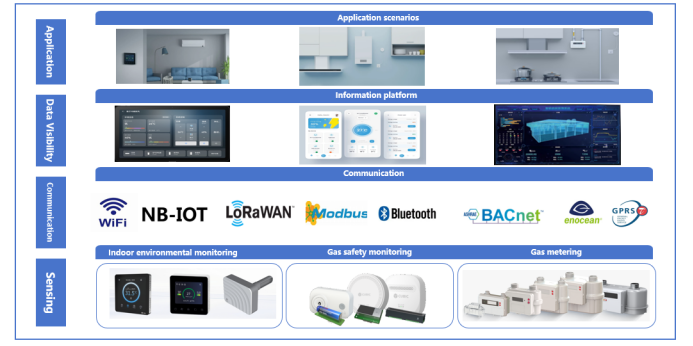
l The Monitoring and Sensing Layer forms the foundation, responsible for real-time and comprehensive perception of the building environment and energy usage conditions. It mainly includes sensing terminals for indoor environmental monitoring, HVAC control, gas safety monitoring, and gas metering.
l The Communication Layer supports multiple communication protocols and technologies including I2C, UART, Modbus, and NB-IoT, ensuring stable and reliable data transmission.
l The Data Visualization Layer presents and analyzes collected data through an information-based application platform.
l The Application Layer focuses on specific application scenarios, including ventilation control, alarm linkage, and energy consumption management, enabling intelligent decision-making and automated control.
With more than 20 years of R&D experience in sensing technologies, Cubic, a leading manufacturer of gas sensors and gas analyzers, focus on the core needs of building energy efficiency and gas safety, the company has developed a series of products including air quality sensors, integrated IAQ monitors, gas safety alarms, and smart gas meters. These products offer high accuracy, long-term stability, and strong scalability, providing a reliable monitoring foundation.
Modern residential building design increasingly prioritizes indoor air quality (IAQ), as exposure to pollutants such as particulate matter (PM), carbon dioxide (CO2), and volatile organic compounds (VOCs) can pose significant health risks. To help maintain comfortable indoor environment, Cubic has provided advanced sensing solutions from IAQ sensors to OEM/ODM HVAC controllers and monitors.
Cubic’s IAQ sensor portfolio is built on proven sensing technologies including NDIR, light scattering, MEMS MOX, and electrochemical principles. These technologies enable accurate and reliable detection of key indoor air quality parameters including CO2, PM1.0/PM2.5/PM10, TVOCs, temperature, humidity, and formaldehyde (HCHO).
NDIR CO2 sensors combine non-dispersive infrared technology with full-range temperature compensation to ensure consistent accuracy, while maintaining compact size and low power consumption. Light-scattering PM sensors feature compact structures with anti-dust designs for enhanced durability and long-term stability. With innovative Auto Particle Identification (API) technology, they achieve more accurate classification of PM1.0, PM2.5, and PM10 under dynamic environmental conditions. MEMS MOX technology supports compact VOC, temperature, and humidity sensors with fast response and flexible integration. In addition, Cubic’s electrochemical formaldehyde sensor adopts a dual-channel structure and unique electrolyte packaging to improve anti-interference performance, enabling simultaneous measurement of HCHO and TVOC concentrations through intelligent algorithms and calibration.
Based on its sensor technologies, Cubic has developed integrated multi-parameter IAQ sensor modules that combine multiple sensing functions into a compact solution. These modules support real-time monitoring of PM1.0/PM2.5/PM10, CO2, VOCs, temperature, and humidity simultaneously, making them ideal for seamless integration into fresh air and HVAC-related systems.
Equipped with I2C digital communication interfaces, the modules ensure stable and efficient data transmission to control units. By providing accurate, real-time IAQ data, the modules enable intelligent system interaction, such as automatic system activation, airflow adjustment, or ventilation control, helping optimize energy efficiency while maintaining a healthy indoor environment.
Beyond sensors and modules, Cubic offers OEM/ODM solutions for customized IAQ transmitters, monitors, and controllers designed for HVAC applications. Transmitters collect and relay sensor data, monitors visualize key air quality parameters for end users, and controllers execute intelligent control strategies such as airflow regulation, ventilation switching, and system optimization.
As an OEM/ODM partner, Cubic supports the entire product development process, from sensor integration and hardware design to software development, mold tooling, and prototype validation. Backed by strong mass-production capabilities and rigorous quality control systems, Cubic delivers scalable and reliable customized HVAC controller and monitor solutions for intelligent IAQ management.
Safety is the most fundamental requirement for natural gas applications. A single undetected leak can result in catastrophic consequences such as explosions, poisoning, or severe property damage. In residential settings, incomplete combustion remains one of the leading causes of carbon monoxide (CO) poisoning worldwide. To prevent these hazards, Cubic offers a comprehensive portfolio of gas sensing technologies, ensuring complete protection for household use.
In homes, gas monitoring is primarily aimed at protecting families from accidental leaks and harmful gas accumulation. Residential buildings commonly rely on natural gas pipelines, LPG cylinders, or other fuel sources for daily cooking and heating. While these systems provide convenience, they are also susceptible to failures such as pipeline aging and corrosion, loose connections, or malfunctioning appliances like stoves, heaters, and boilers. In poorly ventilated areas, even minor leaks can quickly accumulate to dangerous levels.
To help mitigate gas safety risks, Cubic leverages its mature sensing technologies to deliver fast and accurate gas detection solutions tailored for residential safety. Cubic’s innovative self-developed four-channel NDIR methane (CH4) sensor, offers high sensitivity, rapid response, and strong resistance to common interferents such as acetic acid and ethanol, which makes it ideal for detecting methane leaks from household appliances and gas pipelines.
In addition, Cubic’s electrochemical CO sensor ensures reliable detection of low concentrations of carbon monoxide caused by incomplete combustion or poor ventilation. The sensor’s stability and sensitivity enable early warning before hazardous levels are reached, significantly reducing the risk of CO poisoning.
Cubic also provides mature OEM/ODM gas alarm platforms for CO and CH4 monitoring. These gas alarms feature fast response, stable performance, and compact design, making them well-suited for integration into smart alarms, home safety networks, and connected home systems.
Cubic’s residential gas safety monitoring solutions are designed with ease of use and accessibility in mind. Compact detectors can be installed in kitchens, basements, or near gas appliances for continuous monitoring. When gas concentrations exceed safe thresholds, the device issues both audible and visible alarms, prompting occupants to evacuate, ventilate, or shut off the gas supply immediately.
Smart metering is essential for achieving efficient, transparent, and sustainable resource management, which enables precise, real-time measurement of energy and utility consumption.
Based on advanced ultrasonic sensing technology, Cubic develops ultrasonic gas meter modules designed for high-accuracy and reliable residential smart metering applications. The residential module portfolio includes USM-MN/MP-G1.6/G2.5/G4 and USM-MN/MP-L-G1.6/G2.5/G4, supporting air, natural gas, natural gas blends with up to 23% hydrogen, and LPG. With no moving parts, the modules provide stable operation, low pressure loss, low power consumption, and strong resistance to contamination. Optimized flow-channel structures, built-in temperature compensation, and optional pressure compensation ensure stable performance under varying operating conditions. Compact designs with UART/TTL digital interfaces enable easy integration into smart gas metering systems. The modules comply with OIML R137 and EN14236 Class 1.5 standards.
Based upon the self-developed ultrasonic modules, Cubic also provides complete residential gas meters (G1.6–G6) using TOF ultrasonic technology with Class 1 accuracy. The gas meters provides precise measurement across wide operating conditions and feature compact, easy-to-install designs compliant with OIML R137 and EN14236 standards. To further enhance gas safety management, the meters can automatically shut off gas supply through integrated smart valve control when connected with Cubic gas leak alarms.
As intelligent and data-driven building energy management becomes a global trend, the reliability of sensing infrastructure plays a critical role in ensuring the effectiveness of monitoring and control systems. Cubic’s technological expertise, product durability, service capability, and global supply capacity are key factors in ensuring the long-term reliability, availability, and regulatory compliance of the overall system.
With more than 20 years of continuous R&D investment, Cubic has established comprehensive gas sensing technology platforms and strong capabilities in sensor development, product engineering, and large-scale manufacturing.
By integrating high-precision sensing technologies, reliable hardware design, and intelligent data processing, Cubic provides stable and trustworthy monitoring data for key building parameters such as indoor air quality, gas safety, and energy usage. These capabilities enable seamless integration with building automation systems, HVAC platforms, and smart home ecosystems, supporting applications including environmental monitoring, ventilation control, safety warning, and energy efficiency optimization.
Through reliable sensing solutions, scalable production capacity, and global supply capabilities, Cubic empowers partners to build safer, healthier, and more energy-efficient buildings, contributing to the broader transition toward low-carbon and sustainable building operations worldwide.